Showing posts with label mixology. Show all posts

Wednesday, November 13, 2013

Salt Your Cocktail

{via Booze Nerds}

Any baker worth his salt (sorry, couldn't help it!) will tell you that adding salt to sweets is one of the most basic elements of baking.

If you can actually taste the salt--with the exception of purposely salty confections, like salted caramel anything--you've added too much. The goal is to add just enough salt that you can't actually taste it, but that it manages to accentuate the existing flavor notes and heighten the nuances.

The delightfully inventive people over at Booze Nerds ingeniously applied this concept to cocktails:
"We first found out about salt in cocktails at an Irish whiskey tasting. The host said that mixing with Irish whiskey is challenging because it’s a subtle spirit, however he felt salt could help accentuate the flavors of the whiskey in drinks. Naturally, we were intrigued and started noodling with salt in drinks when we got home."
I was doubly intrigued when I saw that their test cocktail, The Spaniard in the Rye, used WhistlePig Rye, which we happen to be doing a joint event with next Monday at Ward III.
"The Spaniard in the Rye We first mixed up The Spaniard in the Rye, a cocktail that we developed a while ago that calls for a bit of salt to brighten the flavors of the drink.

  • 1 1/2 oz Spanish brandy
  • 3/4 oz rye
  • 1/4 oz Cointreau
  • Tiny pinch of salt
Stir with ice, strain into a cocktail glass. 
No Salt:
  • Nose: Raisins, figs, candied orange peel, little bit of rye, clove and black licorice.
  • Palate: Sweet orange at the front, supported by strong rye spiciness. Dried fruit and nutmeg (kind of like fruit cake) along with sweet sherry notes on the mid-palate. A bit more rye spice on the close, but a somewhat flat finish. Probably why we added salt to this recipe when we were putting it together.
Salt:
  • Nose: Pretty much identical to the no salt version with maybe a little bit less of the raisin notes.
  • Palate: Semi-sweet, almost pickled orange at the front, kind of like chutney. More orange, bitter chocolate and black pepper on the mid-palate, less fruit cake notes. The raisin-y dried fruit is still there, just more subtle. Perks up the finish with more spice, barrel, and orange notes. Has a slightly smoother mouth feel. Overall, more of the complex flavors pop, and all of the flavors are a little bit brighter. Shaun felt it was less bitter and a bit sweeter than the one without salt, whereas Christa felt the opposite, that it was slightly more bitter and less sweet."
With the exception of Spanish Brandy (which I'm sure is easy to come by), I have all of these ingredients at home, so I'll definitely be testing it out, both with and without salt. 

For more innovative cocktails that use salt to enhance flavor, including the Ritz Sidecar--which, with Ritz being my family name, I'll definitely be testing out as well--check out the rest of Booze Nerds post, Salt


Monday, September 23, 2013

Smoke Tincture


What makes a cocktail distinct is its ability to have different aromas co-mingle without stepping on each other's toes.

In a Manhattan you have the spice from the Rye that is complemented by the bitterness of the vermouth and topped by either the syrupy sweetness of the cherry or the freshness of a citrus peel. In a Sazerac you have two distinct liquors with arguably opposite flavors--Rye and Absinthe--that somehow manage to beautifully cohabitate in the glass.

Usually, the aromas are inherent to the ingredients you're mixing into the cocktail, but often they're added in more artificial ways like garnishes (cherries or citrus peels or candied ginger), or flavored simple syrups (which impart a flavor and sweetness at the same time). Another way to include a separate aromatic layer is with a tincture. Elana, from Stir and Strain, describes a tincture:

"Well, I read a bit for this post and pretty much what it came down to is that a tincture is the essence of the ingredient you steep in a neutral grain alcohol. It can be used in small amounts by itself, or added with more ingredients for compounds like bitters. Because it is steeped in a high proof alcohol, you don’t shoot it back in a giant gulp. It would also probably taste awful. With an infusion, you are also extracting the essence of what you are putting into the alcohol, but it is co-mingling with the base spirit for a new combined flavor. You might see sour cherry bourbon, lemon lavender gin, something along those lines."

She went with Smoke as an aroma, for Mixology Monday's theme, to complement a Boulevardier Cocktail. 

"For this particular use of smoke in a cocktail, I didn’t want the drink to continue to be steeped in smoke. What I wanted here was for the initial smell to be a deep, meaty smoke aroma, and then when tasted, you were only getting the cocktail. This beautiful smoky aroma would make the drink a surprise for the person drinking it, hopefully a pleasant shock. The aroma would then dissipate as one continued to finish the drink. I chose a Boulevardier to accompany the smoke aroma."

Usually when we think of smoky drinks our mind goes to Scotch, which, if from the Islay region, has a distinct smokey, "peaty" aroma, that comes from when the barley is toasted using smoke from burning ocean peat. In the case of Scotch, the smoky flavor is imparted long before the distillation process. However, sometimes a smoke flavor is added afterward, as more of a finishers. I've had smoked bourbons where there already distilled and aged bourbon is smoked (usually with mesquite). 

The flavor is much less subtle than in Scotch and it kind of tastes like you're drinking a glass of bourbon while standing next to a barbecue. 

A tincture, on the other hand, is added to the cocktail as one of several  components, rather than integrated directly with the primary liquor, which allows the aroma to comfortably exist alongside the flavors of the drink. The tincture doesn't overpower the taste of the cocktail itself, as it's more of a perfume than an ingredient. The initial smell of the smoke layers on another dimension for the palate, but ultimately the flavor of the cocktail remains unchanged. 


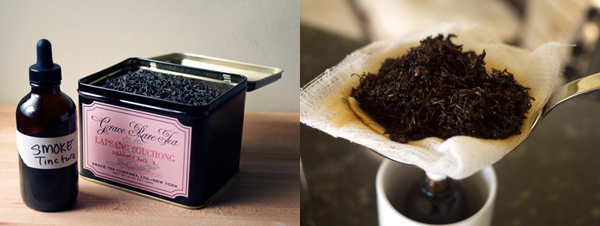
Lapsang Souchong Tincture
From Stir and Strain
1/2 cup grain alcohol (I have 151 proof everclear)
1/4 cup Lapsang Souchong Loose Tea
Combine the two ingredients in an airtight glass container. Let sit for two weeks in a cool, dark place. Gently shaking every few days. After two weeks, strain with a fine mesh strainer with a double layer of cheesecloth. You want to make sure you are getting all the tiny bits of tea out. If you still see residue, strain an additional time. Store in a dropper bottle.
Lapsang Souchong tea has a heavy smoke aroma. When you open the box it’s like getting hit with a face full of wood smoke. As a tincture, the essence gets meatier (as in smoked meat).
Being so easy to make, it seems silly not to experiment with different kinds to jazz up future home bar creations! I for one, being a lifelong fan of Lapsang Souchong tea, cannot wait to try this. 
For the Boulevardier Cocktail recipe, using the smoke tincture, visit Stir and Strain

Wednesday, October 10, 2012

Make Mine Manhattan

 The Manhattan...

"...it’s a cocktail that requires a whole host of decisions. Rye or bourbon? Perfect (composed with equal measures of sweet and dry vermouth), or just sweet vermouth? Bitters? Garnish? Rocks? My advice is to try the Manhattan every which way (just not all at once), because different versions suit different moods. 

According to legend, the Manhattan was created some 140 years ago, at New York City’s Manhattan Club, for a banquet held by Jennie Jerome, Winston Churchill’s Brooklyn-born mother. This tale has been debunked, but I still like to think it’s true, for the strong sense of time and place it suggests."

Read on for more about the Manhattan. 

{Photo credit: Sarn Kaplan, NYT}


And here are two of the best recipes found in New York:


Ingredients

  • 2 oz. Basil Hayden’s bourbon
  • 3/4 oz. Punt e Mes Italian vermouth
  • 1/2 oz. Apricot liqueur
  • 2 dashes Angostura bitters
  • 1 Luxardo cherry.

Preparation

1. Stir over ice and strain into a rocks glass over fresh ice. Garnish: Luxardo cherry.
 
Moo's Manhattan

Ingredients

  • 2 1/2 oz. Old Overholt rye whiskey
  • 1/2 oz. Martini & Rossi sweet vermouth
  • 1/2 oz. Carpano Antica Formula
  • 3 dashes Angostura bitters
  • 1 1-by-3-inch slice lemon peel
  • 1 brandied cherry.

Preparation

1. Pour wet ingredients into a mixing glass. Add ice and stir for 30 seconds. Add another dash of Angostura to a chilled coupe. Twist the lemon and orange peels directly over the coupe. Vigorously rub the peels inside the coupe, then discard them. Add 1 brandied cherry. Strain the liquid into the prepared glass.
 

Tuesday, October 9, 2012

WWW Homework: Whiskey Tasting at Ward III

One of the best parts of being the founder of Women Who Whiskey is getting to plan future wWw events. And one of the best part of planning for the events is doing the homework.

I never plan an event in a place I haven't personally tested out myself--I'd be remiss if we showed up and our expectations weren't met.

Last night Samantha and I went on a recon mission to Ward III.

Indeed, we have already been to Ward III for an event, Women Who Whiskey: Graduation Edition.

But last night was special: Whiskey Mondays at Ward III, where booze reps come in and host a free tasting of a selection of liquors.

It's a recurring Ward III evening I'm hoping to plan a Women Who Whiskey event around, and I'm pleased to say that it was a delightful and educational experience.

We tried three different alcohols: rum (light and dark), whisky, and absinthe. Below are my photos and notes from the tasting.

Banks Blended Rum

Banks Rum is a blend of 21 different rums from a number of different countries, which gives it an even, spiced flavor that isn't too sweet. Both the dark and white rum has a butterscotch bouquet, but the flavor was far from syrupy--which is what I usually dislike about rum, so I was pleasantly surprised.


Florent, the charming and handsome (and French) brand manager told us all about the different rums they blend together--from Indonesian rum to Jamaican rum--and gave us a booklet of Banks rum cocktails. 

Banks Negroni

2 oz. Banks 5-Island Rum
.75 oz. Luxardo Bitter or Campari
.75 Lustau East India Sherry or Martini Sweet Vermouth

Add all ingredients in a mixing glass with ice. Stir and strain into a tumbler over ice, or unto a chilled coupe. Garnish with an orange twist. 


Monkey Shoulder Blended Malt Scotch

Monkey Shoulder is different from other blended scotches because it's a blend of only single malt whiskys. Most blended scotches use a single malt to cover up the taste of grain alcohol, which makes up most of the volume.

Monkey Shoulder is a Triple Malt Scotch--a blend of three single malts--which is why it has a smooth taste, superior to other blended scotches like Johnnie Walker or Dewars. 

It was started by David Stewart, the oldest serving distiller in Scotland--who's been doing it for more than 50 years. It's called Monkey Shoulder, after the common injury that malters use to get from turning the malted barley by hand.


Freddy, the brand rep, taught us how to make the Jam Old Fashioned, a cocktail he came up with consisting of a couple of ounces of Monkey Shoulder Scotch, two dashes of bitters, a couple of splashes of lemon juice, and a dollop of whatever jam you have on hand. Shake it with some ice and strain over ice in a tumbler.


La Clandestine Absinthe

Having French and Italian parents, I grew up with Pastis and Sambuca--both with strong anise/black liquorice flavors, which I love--so it's no surprise that I love Absinthe as well. 

I was delighted to find La Clandestine Absinthe on the tasting menu, and it was fun to watch Alan, the brand rep, pour us the traditional Absinthe and water cocktail with a fancy little thingamajig--called a Broulliar--to slowly drip the Absinthe into a glass of ice water. 

The goal is to bring the alcohol content of the absinthe down to the same strength of a glass of wine--about 13 or 14%--from it's original 53%. Normally this is about 3 parts water to 1 part absinthe.

La Clandestine is an old school no brand absinthe, which was started in 1935 by Charlotte Voucher. It was a bootleg recipe that only recently became an official brand.


We also tried La Clandestina, a deliciously crisp and refreshing cocktail.  Mix equal parts simple syrup, lime juice, and La Clandestine. Shake with ice in a mixer and strain into a chilled glass.

***

It was a wonderful evening--with lots of delicious free samples--and I wholly intent to make a future Women Who Whiskey event out of it. 

In the mean time, I highly recommend checking it out. It's every Monday at Ward III, on Reade St. and West Broadway in Tribeca.

***
11 Reade St.
(corner West Broadway)
212.240.9194
Monday Night Whiskey Tastings
Mondays 8-10pm
Free with the purchase of a cocktail at the bar
***


Friday, September 28, 2012

Pierre Hotel - Fall 2012 Cocktail Launch

September 25, 2012 was the official launch of the Pierre Hotel Fall 2012 Cocktail Launch, where E Lounge--the hotel bar--debuted it's new line of cocktails for autumn.

I was the lucky recipient of a call from my new friend Christine, asking me to be her plus one to this exclusive PR event. 

When I arrived, fashionably late by 15 minutes, Christine was already there, making the acquaintance of the two other PR girls at our table. They had ordered their drinks but were waiting for me to get mine before trying them and comparing. 


The cocktail menu was crafted to reflect the Taj Hotel's transition from the 19th to the 21st century, with remixes of classics like the Whiskey Sour, the Gimlet, and the Sazerac, as well as original concoctions, such as the My Fair Lady of Cafe Pierre and the Star of Taj (a real showstopper, as you'll later see). 

Star of Taj


The Pierre Sparkle

Rotunda's Whiskey Sour

Cheers! Me and my Whiskey Sour
My Fair Lady
Christine with the Pierre Sparkle
 
With a jazz trip playing in the background and subtle lighting the mood was intimate and friendly as we chatted over our drinks and took notes. 

The entire evening was comped by the hotel as a promotional event, and so the drinks and food were plentiful, in an effort to sweeten our experience and elicit sincere positive reviews. 


They then invited us to view the making of two of the cocktails, the Gimlet and the Star of Taj--a spectacular drink that involved setting fresh Indian herbs on fire and pouring the flaming mixture into a fruity cocktail.

Indian Spices

Making the Gimlet


JP Getty's Gimlet


This was accompanied by a delicious tasting menu spread of tiny versions of their new fall menu.


Infusing the Indian Spices

Mixing the Star of Taj


Lighting the herbs on fire


When we'd tried everything on new menu, they brought out their regular bar menu and encouraged us to try some of their regular cocktails and restaurant menu appetizers, in case we were still hungry.

Beef Carpaccio


The Antique Fashioned


Charles' Sazerac

Christine and I were impressed by the skill and speed with which the bartenders were mixing gorgeous and elaborate cocktails, so we went up to the bar to watch, as they explained what they were making and how. 


Vintage Stolichnaya Lemon Vodka--one of a limited number of bottles


A glass of Balvenie, neat, to finish off the night. Courtesy of a Nigerian business man who insisted on buying.

I have to say, this may have been a night where my eyes were bigger than my stomach, and on the cab ride home we were quite a bit tipsy. But it was more than worth it--the staff were delightful, the cocktails divine, and the food delicious. 

I highly recommend both the E Lounge at the Pierre Hotel for a vintage evening where no detail has been forgotten.